Tuesday, July 1, 2014

Bison Stew!

When you've ordered too much (i.e. everything) at Bison Bar & BBQ on Wellington Quay, don't let any of that delicious meat go to waste- box it up, take it home, and give it the ending it deserves in this smokin' Cajun recipe. The meaty Bison sausage has chorizo in it, so bear that in mind when deciding how much chorizo to put in your stew. Also, the brisket has a strong smoky flavour and the pulled pork has a spice rub, so add your Cajun spices according to how much meat you've got.

Ingredients

Bison leftovers (barbecued beef brisket, pulled pork shoulder, chicken leg, pork ribs in BBQ sauce, sausage and pork chunks from the 'burnt end beans'- also smoky and spicy)
8 1 inch chunks of cooking chorizo (to approx 1/4 of Bison sausage- adjust for more or less)
1 large red onion, roughly sliced
3 large garlic cloves, minced
2 sticks celery, strings removed (snap the stalks and pull away the strings), sliced on the diagonal
1 red jalapeno pepper, sliced with the seeds
1 medium courgette,  sliced in 1cm slices on the diagonal, then quartered
1 tin chickpeas, drained and rinsed
1 tin black beans, not drained
1 tin good quality chopped tomatoes
400ml good quality beef stock (I'm not precious about this- even Schwarz roast beef gravy would work here and has the added benefit of a thickener)
Cajun seasoning (ready-made spice mix, or try my blend of paprika, hot-smoked paprika, onion salt, dried Italian herbs, Cayenne pepper, cinnamon, fresh ground black pepper)
Hot pepper sauce (I use Mick's Chilli Inferno No.3 made with habanero pepper), I like a good 2tbsp but you can adjust depending on your comfort levels with heat

Method

In a hot, heavy bottomed iron casserole or deep pot, fry off the chorizo and any chicken skin and bones in 1tbsp olive oil over a high heat until the fats are released and there's just a little colour on the sausage.

Add in the onion, garlic, celery and jalapeno, and sautée for 1-2 minutes. Now add the the Cajun seasoning: If you have a lot of brisket then you need no more than 1flat tsp smoked paprika - more if you need to up the smoky flavour. On the basis of having approx 75g each of Bison brisket, pork, and chicken, I added: 1tsp each of paprika, smoked paprika, dried herbs, and 1/2tsp each of onion salt, Cayenne pepper, fresh ground black pepper and a pinch of cinnamon. Coat the vegetables in the seasoning and let it cook off for about a minute.

Add the courgette and chickpeas and cook for a further minute or two, or until the courgette is just becoming tender. Next add the hot pepper sauce and tinned tomatoes, mixing well, followed by the beef stock. If using stock pots such as Knorr, use approx 400ml boiling water. If using a powdered beef gravy or bouillon, add straight to the pot and add water until you have the consistency you want. Add the black beans - if you're not using a thickener these will help to thicken the pot.

Finally, reduce the heat and add the leftover barbecued meat, stirring well to mix it through the stew. Allow to simmer if you need to reduce the liquid and to ensure that all the meat has come up temperature.

You can serve right away, but this is the type of dish that gets better with time. Serve with savoury rice: sautéed okra (if you can get it) peeled/seeded chopped tomatoes, onion and fresh coriander mixed through boiled white rice or whichever type you'd prefer.            

Wednesday, November 13, 2013

The top 60 (almost) sandwiches in Dublin

From a Twitter poll of sandwich enthusiasts:

    1.    Falafel wraps, Syrian Foods @ Stillorgan Market on Wednesdays
    2.    Sandwich deli, The Runner Bean
    3.    The brisket roll from Bison Bar
    4.    The pulled pork roll from Bison Bar
    5.    Roast lamb sandwich from Poulet Bonne Femme
    6.    Roast chicken sandwich from Poulet Bonne Femme
    7.    Tuna nicoise sandwich from @clodaghmckenna @ArnottsDublin
    8.    Pastrami Melt from The Pig and Heifer
    9.    Provencal Reuben from The Pig and Heifer
    10.    Bacon, roasted pear and Mount Callan cheddar from The Pepper Pot café
    11.    Sausage and relish sandwich from The Pepper Pot café
    12.    Pulled pork sandwich @brother_hubbard
    13.    Sandwich deli, Honest2Goodness Farmers' Market
    14.    Roast chicken sandwich @ Simon's Place
    15.    The chicken sandwich @ Urbun Café, Cabinteely
    16.    chicken, lemon mayo, stuffing and rocket sandwich from Oxmantown
    17.    pulled pork sandwich from Oxmantown
    18.     'El Magnifico' @ pablos tortas from Pablo Picante
    19.    brisket sandwich @PittBrosBBQ
    20.    falafel sandwich @UmiFalafel f
    21.    BBQ Pork Shoulder sandwich @ Green Bench Café
    22.    sandwich deli, Lilliput Stores
    23.    dry-aged Hereford prime steak sandwich @ The Chophouse
    24.    Grilled chicken sandwich @JuniorsDeliCafe
    25.    The Rueben in Bell & Pot Cafe
    26.    sausage bap with caramelised onions@ Cup café
    27.    The porchetta in the Fumbally
    28.    Po Boy at the Ugly Duckling
    29.    Brisket at the Ugly Duckling
    30.    Toasted cheese sandwich in the Stag's Head
    31.    Corned Beef in a roll @ Juno's café
    32.    Beef or breakfast burrito in a bap, from The Fat Peach food truck
    33.    Parma ham panini from Fallon & Byrne
    34.    Rialto (pastrami) @ Dublin City Food
    35.    Muffeletta@ Dublin City Food
    36.    Marino (roast beef) @ Dublin City Food
    37.    Chicken Tijuana Panini from O'Donovan's on Pearse St
    38.    Sandwich deli @ Coppa in the RHA
    39.    pulled pork sandwhich in Le Petit Parisien Café
    40.    falafel, hummus, spinach, carrot, apple & cranberry slaw sambo @Staplefoods
    41.    Poached chicken with harissa mayo at Sip and Slurp
    42.    Club sandwich @ Honest to Goodness
    43.    smoked chicken with extra bacon from the Cake Café
    44.    Hero sandwich @ Junior's
    45.    bacon & sausage blaa, Hatch & Sons
    46.    Fivemiletown goats cheese and root veg blaa, Hatch & Sons
    47.    pulled pork @WhitefriarGrill
    48.    Chicken Hero Parm @ Whitefriar Grill
    49.    Philly cheesesteak at Damson Diner
    50.    pastrami sandwich from Green19
    51.    The Club @ Itsabegal
    52.    striploin steak sandwich from Urban Picnic
    53.    The Steak Sandwich @ Elephant & Castle
    54.    KCP Club from KC Peaches
    55.    The San Diego from KC Peaches
    56.    Warm turkey sandwich from The Lovely Food Co
    57.    baked ham & artichoke @ Mayfield Deli

Wednesday, February 27, 2013

Comfort food

I was having a crappy time lately and I realised that even just talking about about my favourite foods cheers me up, so here's a post about those things I love to cook and eat the most.


COW

Roast Rib of Beef

I like this best of all with a rich gravy, roast spuds and sautéed green beans with shallot butter (a little chopped tarragon in the butter would help create those Bernaise flavours that work so well with beef).

A friend of mine once made me pan roast rib (medium rare) with a buttered baked potato, creamed spinach and fried mushrooms, served with some fab artisanal Sazerac rye whiskey on the rocks...a birthday dinner fit for Don Draper.

The last roast rib of beef I did though - raised in Inishowen, Co Donegal, and aged for 28 days in local food specialist Harry's restaurant - I treated a little differently.

Once roasted medium, I rested the meat smothered with rosemary butter (butter whipped with fresh chopped rosemary and grated nutmeg).

I created a gravy by adding beef stock and a splash of Worcestershire sauce to the roasting juices, thickening with a little flour.

I served the meat with Jamie Oliver's crushed roast sweet potato, with fresh chilli, crushed garlic (cooked off in butter to stop it being too assertive), fresh coriander and sesame oil; home fried baby spuds and some greens. It was a surprisingly good combo- worth straying from the familiar path.

Grilled Ribeye Steak

My other favourite piece of beef is a grilled ribeye steak, usually cooked medium rare but I'm open to change if the cut requires something different.

My dinner is simple and fail-safe: season the meat with freshly ground black pepper and grated nutmeg (salt the meat with sea salt only after it's been frying for a minute or two).

Fry until well caramelised outside and desired done-ness inside, adding butter to the pan and spooning over half-way through. Remove to rest and add balsamic vinegar, a dash of Worcestershire sauce, a tbsp of water and reduce slightly.

For my spinach side, crush one large clove of garlic and sautée without colouring in a generous knob of butter. Wilt 300g of baby spinach and season with salt, chilli flakes and a squeeze of lemon. For a richer variation, add half a tub of creme friache.

Finally, par boil baby potatoes. Drain and cut in half or so that they're bite size. Sautée in about an inch of oil with a hanful of fresh rosemary leaves until crisp and golden brown. Drain on kitchen paper and season with sea salt. This dinner never fails to win over a man's heart!

SHEEP

Poached Leg of Mutton with Caper Sauce

I love mutton. It has a deep, rich flavour from time spent grazing on good pasture. There was a time when this meat was better appreciated then it is now, however, I assure you that when cooked to its best advantage it's up there with the best of meats.

Poach a leg of mutton in a deep casserole in the oven for approx 1.5 hours. Use chicken or lamb stock and white wine for poaching liquor - bay leaves, onions, carrots and a bulb of garlic.

To make the sauce, sautée chopped shallots and capers in butter, add some poaching liquor and reduce, finish with double cream and fresh chopped parsely. Pour over the tender mutton and your choice of veg such as boiled new potaoes.

Roast Rack of Lamb

One of my favourite pieces from one of my favourite animals. Fry the rack for a few minutes to brown the meat and crisp the fat (cut the rack in half if space doesn't allow to do it whole). While the lamb roasts to medium rare, add to the pan a handful of mirepoix, chopped parsely and 2 tbsp of puy lentils. Toss in the meat juices and fat then add a splash of cognac. Cook off the alcohol, add a few spoons of lamb stock, soy sauce and reduce. Spoon the lentil gravy over the cutlets when serving. My favourite sides are rosemary roast potatoes, celeriac purée (boil the celeriac in stock with crushed garlic, then blend until smooth), and sautéed greens with a fresh sharp mint verde (fresh chopped mint leaves, chopped capers, gherkin, anchovy, olive oil and a dash of white wine or sherry vinegar).

Neck Fillet and Chop
I also love lamb shank, breast, belly and leg, however I'm mentioning neck as it's really delicious and underused. Left is my lamb stew using neck fillet pieces - the sauce was thickened with the seasoned flour coating the lamb which I browned before stewing, and a small bit of 100% cocoa solid chocolate which adds a wonderful richness. Neck has a nice quantity of fat so becomes very juicy and tasty when cooked slowly in a rich saucy stew. Serve with mash.

PIG


Slow Roast Shoulder of Pork

There is too little space here to talk about all the parts of pig I love. I think the molten, porky deliciousness of slow roasted shoulder deserves to be towards the top of the list - of course the quality of the animal is most important, and this is only assured by a good farmer who truly cares about the pigs.

Rub the beast with crushed fennel seeds or chopped rosemary, black pepper and plenty of salt. Roast in an oven no higher than 250F (130C) for 8 to 10 hours. Let it rest for a least half an hour once cooked, then watch the meat pull meltingly apart. Some people like to shred the pork, dress with anise-scented spicy sauce and pile it into a soft taco with lettuce, salsa, fresh coriander, and sour cream. Others sprinkle the shoulder liberally with some kind of glaze and give it a smoky grilling on the barbecue. I however, like to pile some meat on my plate, smother in a fragrant tangy gravy (using cider or white wine, stock and flour with the roasting juices), and eat with fluffy buttered baked potato or mash, braised fennel and simply steamed cabbage with butter and black pepper (you could add cream to the cabbage if you want to be more indulgent).

Grilled Chop on the Bone

A lot of people make the mistake of overcooking pork chops, resulting in very tough meat. This spoils the delicious meaty flavour of the pork, and cooking chops on the bone gives even more rich flavour. Once again chosing good pork is essential for best results - breed is important, Berkshire and Tamworth (aka Irish Grazer) are known for superior quality - and a nice cut such as Barnsley chop (centre or loin) is perfect for grilling, baking and frying. Either way can be delicious, but I can't resist the flavours of the grill. Tasty purées of turnip, celeriac or squash make nice seasonal accompaniments, and of course buttered baby carrots, cabbage, roast spiced apple, or even a cheddar mash would be great. It's so versatile you can do pretty much anything with a pork chop - they can dress up or down for any occasion.

CHICKEN
Legs and Thighs in Casseroles

I like a good roast chicken same as the next person - only a good quality free range, often organic birds offers a tasty full figured bird that cooks up well - however, more often than not I prefer to work with the legs. Pan fried and added into casserols and stews they give delicious flavour and fat from the wonderful skin.

Left is a 'cacciatore' (hunter's) casserole, made with tomatoes, peppers, onions, herbs and wine,
slowly cooked for tender results

The Spanish are also fans of these tasty parts in casseroles, and I love the combination of the chicken meat and fat with their typical flavours - chorizo, peppers, paprika and garlic. My version has chunks of cooking chorizo, which I fried off to release its flavoured oils at the beginning, onions, garlic, hot smoked paprika, Serrano chilli pepper, cinnamon, tinned chopped tomatoes, chicken stock, bell peppers, butter beans, baby potatoes and Spanish white wine. I served with smooth butter mash and a cheesy broccoli bake - a very hearty and warming combination for winter nights.

FISH

Poached Salmon

I realise this is just a token fish entry - I also realise how much meat I've been eating rather than anything else! However, one of my favourite fish dishes is a poached side of salmon. 

Rick Stein does a wonderful job poaching the fish in white wine on a bed of finely sliced leeks, carrots and garlic, which are then served with the salmon and a wedge of lemon for garnish. My little lot above is salmon poached in white wine and water, bay leaf and parsely, served with a salad of boiled eggs, avacado, finely shaved red onion, aspargus and baby gem lettuce, cherry tomatoes tossed with chopped fresh dill and white wine vinegar, boiled and buttered new potatoes, and creme fraiche with dill. Tim Adams Clare Valley semillon was a perfect wine match.


Tuesday, February 12, 2013

Mexican stewed black beans


The first of a series of posts about one of my favourite 'cuisines' (Mexican), stewed black beans are the perfect answer to our miserable and unrelenting winter. We don't have many real options in Dublin when it comes to Mexican food, so we have to learn how to make it ourselves...as a matter of urgency. The ingredients for this version are easy to find and simple to prepare, and the results are molten, spicy, warming Mexican shamazballness...get in!

Ingredients 

3 cloves garlic, crushed
1 small onion, chopped
2 serrano or jalapeno peppers, finely chopped (add 1 if you like less heat, or an extra 1-2 Thai chillies if your other peppers aren't hot enough- which sometimes happens with the peppers we buy here)
1 tsp ground cumin
1 tsp ground cinnamon
1 tsp hot smoked paprika
250 ml chicken stock
Juice of 1 lime
400g tinned black beans in salt water (not drained or rinced)
Half a square of Lindt 90% cocoa solid chocolate (optional, but highly recommended)
Olive oil
Salt and pepper to taste

To serve

Fresh tomato, diced
Iceberg lettuce, shredded
Bunch fresh coriander, leaves picked
Red cheddar, grated
Sour cream
Your choice of rice (or other starch)  

Method

1. Sautée (fry) onion, garlic and chillies in olive oil in a non-stick pan for about a minute, without colouring. Add the spices and sautée for a couple of minutes more until their powdery-ness has been cooked out.

2. Add the tin of black beans and mix through. Add the lime juice and chicken stock, bring to the boil and then simmer until the mix has reduced by half.

3. Once it's reached the desired consistency (thick in soupy) - which can be helped by stirring and crushing the beans up a bit - add the chocolate and stir in until it's melted completely. Taste and season with salt and black pepper as you like.

4. To serve, spoon rice (or you could use mashed spud, polenta, nachos, tortilla...whatever you'd like) into the bottom of a bowl, spoon the beans over that and top with grated cheddar, sour cream, the diced tomato and lettuce, and fresh coriander.

Monday, September 24, 2012

A score for rapeseed oil


Rapeseed oil has been dividing opinion among food circles over the last 10 or so years. It’s been hailed as a versatile local product that has a higher smoke point, lower food miles and better health credentials than olive oil. It’s also been blasted as an unsightly, unviable crop that yields too little for the necessary input to make a sustainable, environmentally friendly full-time business, and tastes manky to boot.

The British countryside is covered with it and their markets and even some leading restaurants are determined to promote it. In Ireland, meanwhile, our small handful of producers have been exploiting the brand opportunities of this specialty by-product to great effect, and have won the backing of some prominent chefs in championing it as a great local food.

To date I’ve been on the fence about rapeseed oil. I’m glad to see Irish farms diversifying and creating their own consumer-facing brands – an exercise that would greatly benefit the many thousands of small and medium farms currently tied to commoditised farming for major processors while invisible to the Irish punter. However, I gotta admit I’ve not been the biggest fan of its, at times, bitter and, dare I say it, slightly rancid flavour. I get that it’s good for shallow frying but its ability to work in dressings or other culinary uses is questionable. And it ain’t a cheap option.

I’m pleased to say though that a recent trip to Newgrange Gold in the Boyne Valley swung me on to team rapeseed. Now this – if they can get it to turn a profit in the next five years – could be an interesting proposition for the Irish agrifood sector.

Barrister and part-time beef farmer John Rogers took the decision a little over two years ago to reduce his beef production from 40 head of cattle down to 30 and to dedicate his farm business to seed oil production. The property consists of approx 90 acres of rape – yielding approx one and a half tonnes of rapeseed per acre – and a smaller parcel camelina in North Dublin which produced approx 4000 litres of pressed seed oil last year and almost twice that this year, with 3000 litres in July alone.

At full capacity the farm could produce 300,000 bottles (500ml) of premium cold pressed rapeseed oil, as well as their flavoured rape range in 250ml bottles and their specialty camelina oil (I’ll explain this wonder plant later). All going to plan, they’ll expand production to two presses and will reach capacity and profit-making within five years, and possibly more. On paper it sounds like a good artisanal business plan.

But what of its marketability? Well, most importantly they’re making a product you’d actually want to put in your mouth. From the flavoured range, the Garden Herbs rapeseed oil – a sprightly parsley, sage, thyme and lemon concoction – has just been short-listed for a Blas na hEireann award. Their original rapeseed oil is nutty and lacking in that stinky animal feed/silage/cabbage-y whiff that some rapeseed oils are bangin’ of, and their camelina oil – the only one produced for food in Ireland currently – has the aroma and flavour of freshly ground pine nuts but with a delicate earthiness that works wonders with tomatoes and spices (as we learned from a refreshing shooter prepared for us by the good folks of Eastern Seaboard). Product viability – check.

Inputs and outputs are cleverly managed: sludge from the settling tanks are used to fertilise the plants; husks left behind after the seeds have been cleaned are used for bedding; and ‘cake’ produced after pressing (dry pellets of pressed seeds) make a nutritional animal feed which apparently is in high demand among dairy farmers. Production is clean and involves no adulteration, deoderisation or manipulation of any kind, which lowers input costs and produces a more natural, regionally typified product. Sustainable production – check.

Best of all, without the help of a marketing consultant, Rogers has devised a marketing platform based on a two-fold USP: a Boyne Valley product – Boyne Valley being a region of exceptional quality food production; and a true specialist in seed oils, with a unique product that only they are producing. Camelina is in fact a relative of rape, with a more complex taste and twice the omega-3 content. Its omega-3 and omega-6 content are actually in the highly desirable ratio of 2:1, which according to nutritionists is the optimum for good heart health. Rather than making their camelina oil as a ‘health product’ though, they’ve opted to release it for retail as a pillar or their range. They’re already stocking at specialists and small retailers in Dublin, Louth, Meath, Cavan, Cork, Galway and Sligo, and are in talks with major retailers for national distribution. Marketability – check.

Newgrange Gold has been on shelves since March and only formally launched in September. While Rogers clearly has other irons in the fire, the seed oil business is so far self-funded and going to plan. Rogers says: ‘We are where we want to be.” And by that he means genuinely regional, artisianal, moving towards their potential, and tasting pretty damn good.

Tuesday, August 7, 2012

Ethnic eats in the Olympic city


The Olympics are in full swing, bringing together over two hundred nations in one of the most ethnically diverse cities in the world. In deference to this great multicultural event, here's a few of my favourite morsels to guide revelers through their hungry moments, while they explore the city behind the 30th Olympiad.


Mediterranean, Middle East and South/South East Asia

Nopi

Nopi is a mixture of formal restaurant and communal dining, from the talented team behind Ottolenghi. If you're familiar with this class act of Mediterranean and Levantine cooking then you'll know to expect fresh jewel like ingredients, petite portions, and unique, magical combinations of flavours and textures. For those not yet acquainted with this crew, you’ll find the food at Nopi to be unlike anything you’ve found elsewhere: creamy burrata with flat white peach and coriander seeds; tasty confit pressed duck with a sweet spiced plum relish and walnut horseradish cream; roasted cauliflower with farro (grain similar to barley), sharp barberries, hazelnuts and celery, to give you a few examples. At Nopi you can book a table for lunch or dinner in the formal dining room upstairs, or you could choose to join the communal table downstairs and survey the action in the open kitchen before you. Prices are at the premium end – in keeping with Ottolenghi’s other establishments – but the wine list and cocktail menu will probably tempt you to spend a few quid more. Should be on the to do list of all foodies.

21-22 Warwick Street 
London W1B 5NE
Ph: +4420 7494 9584


Japanese
Sushi Tetsu

A tiny, superb sushi restaurant only newly on London’s gastronomic radar. It’s star is rising so fast, chef-owner Toru Takahash pleaded with Jay Rayner to keep his (rave) review under raps for a while to give him time to get ready for the inevitable deluge. The menu of sushi and sashimi is extensive – all prepared in front of you by the talented and chatty Takahash-san from the freshest of seafood. Among his more unusual offerings, you may sample razor clam, sea urchin, cuttlefish and snow crab. Of the standard species available, Sushi Tetsu offers several varieties of tuna – from cheaper red fin to (‘rich part’) succulent tuna belly – two types of mackerel and sardine, turbot, brill, bass, bream, grouper and lemon sole, as well as eel, salmon, shrimp, octopus, squid and scallop. Takahash often uses a blowtorch to excellent effect, caramelising the surface of a scallop, for instance, to bring out its sweetness and add a mild hint of barbecued flavour. The rolls are tasty and fresh as a daisy, although with all the beautiful seafood on offer, I prefer to save all my room for sushi and sashimi. The drinks menu consists of a few sakes, including a fragrant daiginjo (a higher end sake) called Nanbu bijin that’s worth the extra doubloons. The odd spirit or two, mineral water, green and oolong tea, and a small gathering of Japanese beers complete the drinks menu - Takahash wants to educate London diners about sake before he introduces wine to his restaurant. Sushi Tetsu is going to get harder to get into over the coming months, but I promise it’s worth the effort.

12 Jerusalem Passage
London EC1V 4JP
Ph: +4420 3217 0090


Korean and Japanese

Dotori

Culinary gems are harder to come by in this portion of North London than elsewhere in the city but Dotori is definitely one of them. It’s predominantly a Korean restaurant but a one-man sushi counter turns out a reasonably decent selection of sushi, sashimi and hand rolls. Especially worthy of note are the assorted ‘bibimbap’ – mixed meat or seafood (bbq beef is especially good), vegetables and rice, blended at the table with hot and savoury gochujang (chilli sauce) and sometimes a raw egg, which cooks in the heat of the dish as it’s mixed through. Their hot soups, noodles and tempura are all pretty good too, and the low prices add up to some of the best value going in London for good nosh. Dotori has become a favourite among the throngs of locals so you have to book to ensure getting a table. For the value and deliciousness though, you won’t be sorry to wait if you decide to take your chances.

3 Stroud Green Road
Finsbury Park
London N4 2DQ
Ph: 020 7263 3562


Vietnamese

Mien Tay

The famous ‘Pho Mile’ on the Kingsland Road in Shoreditch has more Vietnamese restaurants than you can shake a stick at, many of them cheap n’ cheerful and BYO, so well suited to the frugal traveller. Among those noted by locals, Viet Grill is reputed to offer a more up-market experience, while Song Que is religiously authentic and boasts a bewilderingly extensive menu that you’ll be left to wade through. I’d definitely recommend getting to both of these if you’re a devotee of the cuisine, however there’s something about Mien Tay that feels like home…almost akin to the atmosphere of old family-run Asian restaurants in Ireland. My favs on their South West Vietnam menu include stir-fried green mussels with ginger and spring onion, green papaya salad with prawns, and chargrilled pork chops with lemongrass and chilli. They have an incredible-sounding seafood hotpot that must be ordered in advance – should you be so organized – and if you’re feeling adventurous you might try some of their more unusual dishes, of goat, frog or eel. One way or t’other, a visit to the global feast that is the Olympics would not be complete without a trip to the Pho Mile.

122 Kingsland Road
Shoreditch
London E2 8DP
Ph:+4420 7729 3074


Caribbean
Bamboula

There are a few Caribbean places worth mentioning in London: Cottons on Chalk Farm Road near Camden is a popular spot for a fun evening among happy peeps enjoying good beats and even better rums, and Jerk Shack on Portobello Road Market pleases the masses with tasty spicy jerk chicken, curry goat, snapper, rice and peas, and fried plantain every Saturday. However, Brixton is the heartland of Caribbean food culture in London, so it is here you’ll find it at it’s most colourful. Bamboula is a fun spot with a great variety of true dishes from the islands: ackee and saltfish, steamed tilapia (fish), jerk chicken and lamb, curry goat, and brown stew chicken or oxtail. The ‘all you can eat buffet’ for £7.99 at lunchtime from Monday to Friday is understandably very popular and a happy find should you be in the area, but you should stop in for dinner and sample some of their fine rum punch, or traditional ‘Guinness punch’ if your constitution can withstand it. Take 2wo jerk stand in Brixton Village and Negril on Brixton Hill are also popular with locals.

12 Acre Lane
Brixton, SW2 5SG
Ph: +4420 7737 6633


Spanish and North African
Moro

In Exmouth Market near Islington you’ll find this fab restaurant which offers an à la carte menu and a list of tapas, available all day Monday to Saturday. The inspiration here is Moorish cuisine but you’ll also find classic Spanish dishes. All will please no end - this is one of the few tapas places that actually lives up to our foodie desires. Among the Moorish flavours you can expect the likes of crab brik with harissa (delicious spiced and herbed crab pastry parcels with the hot condiment harissa) or quail baked in flatbread with pistachio sauce. On the Spanish side you’ll taste roasted pork with patatas pobres (Spanish style) and spicy churrasco sauce, and stuffed squid with fino sherry. If you drop in for tapas you can have a more casual experience with all the usual suspects, including anchovies in garlic oil, grilled padrons and Catalan botifarra sausage. If you can’t get into Moro, fear not, it’s sister tapas bar Morito (just next door) requires no reservations, and offers a nice selection of Spanish cocktails to boot.

34 - 36 Exmouth Market
London EC1R 4QE
Ph: +4420 7833 8336


Mexican
Wahaca

Without a shadow of a doubt the best Mexican restaurant in London IMHO, and some of the best fun you can have with your clothes on! An evening at Wahaca in Covent Garden begins with cocktails and possibly some nachos and meltingly fresh guacamole at the bar – they don’t take reservations and there’s usually around 45 minutes wait for dinner, so this is by far the best way to pass the time. Once seated you can order your choice of nibbles, snacks, salads and mains, all of which are inspired by humble Mexican street foods and made using good British ingredients. Molten pork pibil tacos, melty hot chorizo and potato quesadillas, rich chocolatey chicken mole, grilled steak or snapper, shrimp and scallop ceviche, pulled pork burrito…the list of deliciousness goes on and on. Restraint is impossible, gluttony inevitable and well justified in the presence of such amazing food. It’s not a shrine to authenticity, but then that’s not the point. There are several outposts of this great Mexican chow house, one notably at Westfields next to the Olympic stadium.

66 Chandos Place
Covent Garden
London WC2N 4HG
Ph: +4420 7240 1883


British
F. Cooke

Of course, the most exotic and hard to find outside its own country is real British cuisine, of which there are many fine examples within the city of London. 'Pie n' liquor' is not only a stalwart of British cookery, it's quintessential London grub, and cockney London at that. There are a number of celebrated traditional pie n' mash shops - Clark's in Exmouth Market, Harrington's in Tooting, M. Manze at Tower Bridge (London's oldest pie n' mash shop) - but I've chosen to highlight Cooke's, firstly for their scrummy mince meat pie that could rival my granny's (sorry granny), and secondly because of their location near Broadway Market, which should not be missed by any visiting foodie. So go on and try the eels - in a big spoon of mash and liquor, they're utterly delicious and not even remotely scary! 

150 Hoxton Street
London N1 6SH

Ph: +4420 7729 7718


So that's just a few of my favourite things... as always, please feel free to add your own thoughts below §:)


Tuesday, June 12, 2012

Top Irish chef making a mark in London

I, CB aka DublinFoodie, was barely a wet day in London when I was already blagging my way in – a free sample here, a free glass there…an invite to feast on an eleven course tasting menu at L’Autre Pied (celebrated sister restaurant of Pied à Terre).

But enough bragging about my blagging, all the glory in this post must go to Michelin-starred head chef and Tallaght man Andy McFadden, and glorious is one word I could use to describe his cooking. Playful is another; sensitive, accomplished, beautiful, poetic even, are a few more. Sensitivity and that special kind of poetic licence mark Andy out for me as an Irish chef, as we’ve seen the likes of it in great Irish chefs up and down the spectrum from Kevin Thornton to Denis Cotter. Is it something in our mentality, perhaps? Whatever it is, combine it with mentoring in the cutthroat arena of top London restaurants and the best of British and Irish ingredients and the result is pure poetry.

Imagine just this simple canapé: a shard of beetroot sugar craft – like the sail of a little red boat – guiding in a perfect, molten piece of smoked eel, sashimi-like in precision, flanked by an equally dainty and perfectly formed quenelle of Crapaudine beetroot mayonnaise, and a beetroot crisp, all scented with tapioca. If you eat with your eyes then the dish could fill you. Taste it, and you experience all five tastes of the palate, in perfect harmony. It’s such a complete dish in every way. Now imagine ten more courses, each a playful and sensitive ode to the season: civiche of scallop with mizuna cream and wafers of Jerusalem artichoke; Irish Sika deer cooked in cocoa…Andy McFadden’s work is the work of an artist. The work of a masterly Irish chef.

L’Autre Pied
5-7 Blandford Street
London W1U 3DB
www.lautrepied.co.uk

Wednesday, May 16, 2012

Delicious Ireland celeb chef recipes

RICHARD CORRIGAN


Richard Corrigan is the chef owner of Bentley’s Oyster Bar & Grill and Corrigan’s Mayfair in London. Bentley’s is to open The Sea Grill in Harrods in May 2012.


Salt Marsh Lamb, Gubeen Chorizo, Broad Beans


Ingredients

500g Lamb, Neck Fillet or Best End
250g Gubeen Chorizo
200g Broad Beans
1 bunch Mint
Marjoram
200g Irish Sheep Milk (hard) cheese
50ml Olive Oil
2 Red Peppers

Method

Roast and peel the peppers. Pop the broad beans and slice the chorizo. Season and roast the lamb
until rare. Heat the beans, chorizo, add the herbs, red peppers and cheese. Carve the lamb and
serve.


Wild Rabbit, Black Pudding, Wet and Wild Garlic


Ingredients

1 x Wild rabbit, skinned
250g Black pudding
1 bulb wet garlic
1 bunch wild garlic
1 tbls wholegrain mustard
250g washed caul fat
10 slices parma ham
1 large glass red wine
250ml chicken stock or water

Method

Peel the wet garlic and sweat in a little butter until soft puree and set aside. Remove the legs and
loin from the rabbit. Remove the bones from the meat. Lightly bat out the legs and stuff with black
pudding. Repeat with the loin. Wrap both in parma ham and caul fat.
Roast all carcasses in a hot oven add a little chopped vegetable and caramalise. Deglaze with a glass
of red wine add a little stock or water. Reduce by 2 thirds and finish with a spoonful of mustard.
Lightly roast the rabbit in a hot oven until just cooked and serve with the wet garlic puree and the
wild garlic leaves.


PAUL FLYNN


Paul Flynn, chef and owner of The Tannery restaurant and cookery school, Dungarvan, Co. Waterford, is
renowned for cooking exceptional modern Irish food. Paul’s dishes are known and loved for their deep earthy
flavours - while the menus give nothing away in their simplicity, the experience of eating them is hugely exciting. He
was the cookery writer for The Irish Times and subsequently wrote two cookery books, An Irish
Adventure with Food (Food and Wine cookbook of the year 2003) and ‘Second Helpings’ which
contains a selection of spectacular recipes using seasonal food.


Warm salad of Cashel Blue, Apple and Almonds

Ingredients


250g Cashel Blue broken into bite size pieces
1 large red onion, peeled and cut into 8 pieces
2 apples, remove the core and cut into 12 pieces
2 handfuls of washed baby spinach
2tbsp whole peeled almonds
2tbsp olive oil
1 tbsp butter
2 tbsp red or white vinegar
1 tbsp brown sugar
Salt and pepper

Method

Heat the olive oil and butter in a good frying pan until foaming.
Add the onions and apples followed by the almonds a minute later.
Meanwhile arrange the spinach in the centre of your plates and arrange the blue cheese around.
Turn the apples and onions when they start to colour.
Add the almonds, sprinkle over the sugar, shake the pan to coat everything evenly
Cook for a further 2 minutes then add the vinegar and allow to bubble a little
When the apples are soft and golden, spoon the mixture onto the prepared plates and serve
immediately.


Iced Meringue Cake (Serves 8)

An ice-cream cake is a really impressive dessert. Deceptively simple to make and simply served with

whatever fruit is in season. A real hit at kiddies parties, decorated in the most gaudy, sugary ways possible.

Ingredients

8 meringue shells
400mls fresh cream
2 drops vanilla extract
1 tbsp icing sugar
Lemon Curd (see recipe below)
Selection of summer berries

Method

Whisk the cream until medium to firm peaks with the vanilla extract
Break the meringue shells into the cream and fold gently until well mixed
Transfer to a bowl lined with cling film and freeze overnight

Lemon Curd (or buy a nice one!)

Ingredients
110g caster sugar
110g unsalted butter
1 fine zest and juice of 1 and half lemons
1 whole egg
3 egg yolks

Method

Place everything except the butter in a bowl and whisk well
Cover with Cling film and microwave on half power for 1 minute, but stop and whisk every 20
seconds
Add the diced butter and again microwave for 1 minute stopping every 20 seconds to whisk
Continue this until the curd has thickened, allow to cool.
To serve
Take the cake from the freezer up turn onto a dish and remove the cling film.
Scatter the berries around and serve with the lemon curd.


Butterbeans with Chorizo, Black Pudding and Cider


Ingredients

1 tin of butterbeans
5 sprigs of sage
1 medium onion diced
1 clove of garlic, chopped
1 tbsp of butter
½ chicken stock cube crumbled
1 tsp smoked paprika
100g chorizo, sliced
100g Black pudding, diced
1 bottle of dry cider
1tbsp of tomato puree
Salt and pepper

Method

Cook the onions slowly in the butter with the sage and garlic, add the tomato puree and the smoked
paprika, cook for a further 5 minutes. Add the chorizo and allow the oil to come out, add the
pudding, cider and stock cube.
Bring to a simmer and cook for 5 more minutes
Season and serve


DERRY CLARKE


Derry Clarke has been Chef/Patron of l’Ecrivain in Dublin for 23 years now. Derry and
l’Ecrivain have been awarded many accolades over the past twenty years, including a Michelin Star
which was awarded in 2002. Derry’s food ethos is simple: He sources the finest fresh local produce and he believes that a good dish is only achieved using the highest quality ingredients.


Slow Cooked Skirt Steak with Turf Smoked Carlingford Oysters, Organic Spring Greens & Morel Mushrooms

Pt1: Beef
Ingredients
800g beef skirt (trimmed of excess fat and cut into 4 pieces)

2 carrots, peeled and sliced lengthways
2 sticks celery
1 onion peeled and sliced in 4
1 bulb garlic cut in half
250 ml chicken stock
1 big spring of thyme
2 bay leaves
Freshly ground pepper & Sea salt

Method

Season the beef with the black pepper and salt. Heat a frying pan over a moderate heat, add a little


vegetable oil and sear the beef on all sides till nice and brown. Place the vegetables, herbs and
chicken stock into a roasting tin and place the beef on top.
Preheat your oven @ 70 degrees Celsius or gas mark 2/3 and cook the beef in oven slowly for 2
hours ( this will tenderize the beef). Remove and leave to rest for 10 min.

Pt 2: Oysters

Ingredients

12 Carlingford Oysters ( opened, flesh removed, Reserve Jus)
100g turf or any woodchips
2 bay leaves

Method
Place turf or wood chips into a small roasting tray with the bay leaf. Place a wire rack over the turf
and cover the roasting tin with tin foil. Place tin on low heat for 2/3 min and pull back tin foil and
place the oysters onto wire rack, cover over the tin foil and over a low heat gently smoke the oysters
for 3/5 min. remove from tray and leave to cool. ( you can also use this method to smoke chicken,
pork, salmon, mackerel, vegetables etc.)

Pt 3: Spring Greens

Ingredients
60g peas ( frozen are fine)
60g broad beans
60 g French beans
12 small asparagus spears

Method
All of the above to be blanched.

Ingredients
2 shallots finely diced.
200ml chicken stock
200ml white wine
200 ml cream
50g butter
Freshly ground Sea salt & freshly ground white pepper

Method
Heat a sauce pan over a medium heat, add the butter and the shallots, sauté for 2/3 min add
the chicken stock and reduce by half, add the cream and gently reduce until you have a sauce
consistency. Season with salt & pepper, add the veg and heat for 2 min, add the oysters & the reserved Jus, Keep sauce warm.

Pt 5: Morels (or any mushrooms)

Ingredients
100g morels (or any other mushrooms)
Toss the morels in a pan with a little butter.


Presentation Method

Spoon the sauce & spring greens onto your plate, slice the beef across the grain and place on top, spoon on the morels.

Tuesday, May 15, 2012

Eat me, I’m Irish!

A lot of us Irish have left the island in recent years, for Oz, the US of A, the UAE, of course the trusty ol’ UK, and other far off lands greener and sunnier than our own bankrupt, drizzled-upon country. Migration is an Irish specialty. We love to travel, and we always seem to fit happily in wherever we land, benefiting from a certain affection – a benign condescension, if you will – which allows us to get away with the most audacious invasions when others would be resented by the natives. Even when our residence in their country is not always on an (ahem) official footing.

 I have witnessed the phenomenon myself, as an Irish girl now living in London (I like to think of myself as being on an anthropological excursion as opposed to being an economic migrant). But who could blame them? Aren’t we endearing with our rowdy cheer and our Guinness, and our longing for ‘real butter’ and Tayto crisps? We’re friendly and familiar – amusing when exchanged with British politeness and reserve – and we have our own peculiar wisdom which in the wrong hands could cross the line into asininity. In short, ‘Irishness’ involves a combination of things that makes people fond. Ireland itself is an evocative place that fills others with romantic thoughts and a desire to go there. ‘Irishness’ evokes some of the good things in life, and so everybody wants to be a little bit Irish – or at least able to finish a pint of Guinness.

Besides our most famous exports – namely ourselves and the black stuff – other Irish produce is making its way to foreign food stores and restaurant kitchens. Only recently I had Irish Sika deer in a top London restaurant, and saw Irish cheeses on sale in the deli counters of exclusive retailers. In Ireland we ourselves are only now learning that our food is a thing we do very well, and this will be our greatest ambassador yet.

So, proud I was to walk into Selfridges last month – a top fancy retailer in London, for those who don’t know – and see the food hall bedecked in green, adorned everywhere with the produce of Irish artisans in celebration of ‘Delicious Ireland.’ DI was the title of a promotion that ran for the month of April, promoting a great array of Irish food and beverages from dairy products to whiskey. Personally, I think we should change the name of our country to Delicious Ireland.

Below I’ve given an abridged list of the Irish foods on display at Selfridges last month – but to really show them all off properly the good people of Bord Bia enlisted the help of some celebrity chefs to fashion them into dishes in sprint-like cookery demonstrations – and you’ll find some of the recipes HERE

The artisan line-up included:

 Ballymore Farm’s beautiful handmade organic unpasteurised butter – which can be found at good food shops throughout Dublin
and Wicklow

Irish farmed organic Irish-smoked salmon from the inimitable Burren Smokehouse. Their exceptional products are exported as far a field as North America, but you’ll find them stocked all over Ireland – and a visit to the smokehouse if you’re in the Burren is the best way to buy them  

Chia Bia’s innovative range of breads, bars and seed mixes – brimming with all the health-giving properties of chia seeds  

DP Connolly and Son’s natural juices, lemonades and cordials, made from Irish orchard fruit with no preservatives

A fantastic range of bespoke spice blends from Green Saffron, the award-winning Cork based business that specialises in whole fresh spices. You’ll find their unique spice products at Mahon Point and Midleton farmers markets in Cork, the Limerick Milk Market, and various specialist retailers around Ireland

The innovative ‘Orchard Syrup’ from Highbank Orchards in Kilkenny – Ireland’s answer to maple syrup!

Ireland’s ‘it’ pudding, Jack McCarthy’s black pudding – so good the French gave the butcher a knighthood for it and we served it to the Queen on her visit! Find it, well, everywhere these days    

Mella’s delicious buttery fudge, handmade in West Cork using local butter  

Sheridan’s range of crackers, chutney for cheese and onion marmalade – designed to perfection to accompany their massive stock of Irish and imported cheeses and charcuterie. A visit to Galway, Dublin, Waterford or Carnaross, County Meath is not complete without a visit to Sheridan’s

Can you imagine ‘Holycross Chocolate Biscuit Cake?’ The Tipperary Kitchen in Holycross Village, Co Tipp can show you this Belgian chocolate and local creamery butter wonder

Delectable chocolate truffles from the Truffle Fairy – such as Tequila Salt and Lemon truffles – find them in Waterford and Kilkenny Farmers Markets, and the People’s Park Dun Laoghaire market in Dublin, as well as some shops around Kilkenny

One of Ireland’s favourite cheeses, Ardrahan, lovingly made in Kanturk, Co Cork since 1983. You’ll find this on any cheese board worth its salt, and most cheese counters throughout Ireland
To satisfy the cheese fanatic, click here to see the other stunningly good Irish cheeses at Selfridges

Lastly but by no means leastly, from Northern Ireland:  
Clandeboye Estate artisan yoghurts (made in Bangor using milk from the estate’s own award winning Holstein and Jersey herds);  
Five Mile Town Creamery soft and hard cheeses (including smoked and plain cheddar, brie and flavoured goats cheeses);
and the very innovative Good 4U’s range of sprouted and roasted seeds, functional drinks and healthy snacks (produced by a family-owned health food company in County Tyrone).


All of these products and many more are available at Selfridges’ food hall. If you don’t make it to Ireland to experience its deliciousness for yourself, do look out for whatever morsels you can find elsewhere …and we are everywhere these days, so it’s the least we can do to share our goodies.

Irish artisan cheeses now available at Selfridges

Glebe Brethan (comté-style cheese from Co Louth made by David Tiernan from raw Montbeliarde cow’s milk)  

Bellingham Blue (a raw cow’s milk blue from Glyde Farm, Co Louth)

Cashel Blue (Ireland’s first blue, a semi-soft cow’s milk blue made by the Grubb family in Tipperary, who also make Crozier Blue, a raw sheep’s milk cheese)  

Cooleeney (a brie-style cheese made from Friesian milk by the Maher family in Tipperary, who also make the soft goats cheese, Gortnamona)  

Durrus (a traditional raw cow’s milk cheese – one of the first farmhouse cheeses made in Ireland – made by Jeffa Gill since 1979 in West Cork)  

Gubbeen (a semi-soft cow’s milk cheese, also made in West Cork since 1979, by Giana Ferguson. Her son Fingal now produces a range of cured meats and charcuterie under the Gubbeen Smokehouse brand)  

Hegarty’s Cheddar (another famous Irish cheese made in Cork, from Friesian milk)  

Killeen Farmhouse (goat and cow’s milk cheeses, produced by Dutch-born Marion Roeleveld in Balinasloe, Co Galway)  

Knockanore Smoked (a smoked full-cream semi-soft cheese made since 1987 by Eamonn Lonergan, from Lonergan Pedigree Friesian cow’s milk, in Co Waterford)

 Knockdrinna Farmhouse Kilree (complex rinded goats cheese produced by Helen Finnegan, along with an outstanding range which also includes Knockdrinna Gold, Knockdrinna Meadow sheep’s cheese, and Lavistown)  

St Tola Organic Goats Cheese (an internationally acclaimed gourmet cheese made in County Clare by Siobhan Ni Ghairbhith since 1999, when she acquired the business from her neighbours)  

Wicklow Blue (a semi-soft rinded blue with a very creamy flavour, made by John Hempenstall in Co Wicklow from pasteurised Friesian milk)

Thursday, June 9, 2011

A Foodie Road Trip (Northwest/West of Ireland): Part III

The Epic Feast at VM @Viewmount House, Co Longford

Stepping inside we were greeted by one half of the Viewmount House team, Beryl Kearney, who owns and runs the place with her husband James. Her manner, like her Georgian guesthouse, is full of warmth and pretension-less ease. We were welcomed and seated in the cosy reception area, where Beryl entertained us like the kind aunt of some students who’d just come home from a school trip and were chattering away about their adventures. Then we ordered another bottle of prosecco – this time a pink one – and settled in to work through the menus.

We were in no rush. As we discussed the promising options we noted that four is really the optimum number for a group on a foodie excursion. As was the case in most of our previous dining experiences, we resolved to order every single dish to share – with four you get to try most of the menu and the group is neat enough to share around without too much hassle (or without the risk of any dish getting hogged by some person in an advantageous corner of the table). We have few rules on the foodie road trip, except the golden two: every one eats everything and everyone shares everything. Failure to comply with the latter especially will result in food mugging followed by expulsion.
Quail slider with tomberries

No fear of that with our group of foodies thankfully, and we all looked forward to the meal ahead as we were led into the expansive stylish yet rustic dining room. We were seated by a window with a view of the front garden – a rabbit actually frolicked by just as we were admiring the scene (perhaps bribed by the house with a bag of acorns... although that’s probably unlikely). Then without much delay, a pre-appetiser of mini quail burgers was brought out.

Tasting of pork
Inside the little slider, the nugget of quail meat was tender and succulent, while the other fillings, including caramelised onion and fresh rocket, were delicious and apt in their gourmet burger-ness. The toasted bun was just right, not too dense, and the accompanying tomberries and balsamic reduction on the plate gave a refreshing zing at the end. We scoffed them, and then wanted more.

As we awaited our starter, the server advised us not to eat too much of the fresh baked bread he’d just put in front of us, considering the number of courses we were about to consume. Not ones for restraint, however, we finished off the Guinness and treacle, olive focaccia, and French baguette with the cherry pepper hummus dip accompanying them, and then found ourselves asking him for more. I pity the fool who tells us to stop eating!

'Beef wonton'
Then came the starters: (1) Lissadell mussels with ‘Asian Junction Green Curry Coconut Broth’ (with shiitake mushroom, pineapple, scallion and coriander); (2) ‘Anise Orange Cured Thornhill Duck Leg Confit’ (with beetroot, mushroom, tarragon and sherry ragout); (3) ‘Wonton of Slow Cooked Donald Russell Beef Cheek’ (with Yorke's Swede, butternut squash, onion jam, ratatouille and pickled cucumber); and (4) the glorious ‘Tasting Plate of Irish Pudding and Rare Breed Pork’ (Jane Russell's black & Clonakility white pudding terrine, manuka-glazed rare breed pork cheek, pulled shoulder confit, and vegetable spring roll).

You may probably guess, as we rotated the dishes about the table with the precision of structural engineers, that the pork plate was the big crowd pleaser. Unctuous ribbons of tender meat in mellifluous culinary adonrments …I realise this is flouncier food writer tosh than I normally commit to paper (or screen), but I’m struggling to communicate the deliciousness of this pork dish without resorting to such loquacity. It was freakin’ amazing tasting, okay! Likewise the duck, while not the celebrity that pork has become these days, was equally delicious as it did it’s own thing. Rich gamey leg meat which was enveloped in the mouth by a pleasing balance of earthy and sweet flavours, all comforting and hearty. The beef cheek wonton was another goodie, with umami and sweetness reminiscent of the quail burger (sooooo good) with an added twang of acidity. Finally the mussels – which struggled to get a look in next to the meat dishes (lets face it, meat rocks) – were, of course, also beautiful to eat, with flavours that were delicate yet individual and interesting and made you keep digging until the very last bite was gone.

Second course in and we were reveling in pure satisfaction. The foodie equivalent of wanting to light up after a mouthgasm (as Ed Hick would say …love that man). The plates were cleared and we sat smiling stupidly at each other – I think I hallucinated another rabbit in the window – and we waited for our ‘middle courses.’

Gardens at Viewmount
We ate more bread.

So, on to round three and out arrived our ‘Taste of the Midlands Salad’ (containing O’Halleran’s free range egg, spinach leaves, Kelly’s organic soft cheese (as in the Moonshine Dairy), Rogan’s whiskey oak-smoked bacon, capers, herbs from the Viewmount garden (as seen earlier in Gary O’Hanlon’s hand, fresh from said garden), red onion, red wine vinaigrette, and roast pear). Times two. Also arriving for our delectation was a very special chicken and sweet corn soup, prepared using the early sweet corn from local Carrickboy grower David Burn (whose produce is showcased in Chapter One’s legendary sweet corn soup and is much vaunted by fellow advocate Ross Lewis). Soup was also times two.

Venison
The salad was fragrant and beautiful to look at and eat, bringing to mind the artistry we’d seen at Kai in Galway earlier that day. It was the kind of dish that could be used as a billboard for Irish tourism – a real reminder of how far Irish gastronomy has come and an example of how lucky we are in this country in terms of everything we have on our own doorstep. The soup, on the other hand, was pure comfort and deliciousness. While the salad eaters were waxing lyrical about its beauty and freshness, the soup eaters were making non-verbal sounds, head down and not handing it over. It was meaty and sweet and rich (probably quite fattening) and just gorgeous to eat. You could happily guzzle a big bowl of it for a meal – dangerously good stuff.

Mutiple mouthgasms (Hick, 2011). At this point, our waiter announced that chef was treating us to some special palate cleansers, and within a short while some jewel like little pots of vibrant pinky red rhubarb jelly topped with Moonshine Dairy organic natural yoghurt appeared. We were instructed to make sure to eat both together, as the rhubarb was too sweet and the yoghurt to sour to eat solo, while together they made a perfect combo. This was sound advice. Yummy. Also delivered were two bouls of mojito sorbet, each topped with a purple sprig of mint from the garden. The consensus quickly reached was that it was good mojito, frozen or not.

Lamb
After the cleansing reprieve, we resumed course on our culinary extravaganza and eagerly awaited the mains, even though we may have been feeling a touch full at this stage (not enough, naturally, to slow down the expedition to the top of mount glutton). For round four, we received: (1) ‘Finnebrogue Farm Oisin Venison Saddle’ (with candied Yorke's Swede, red wine celeriac, and Valrhona chocolate berry sauce); (2) ‘Raz el Hanout rubbed Roscommon Spring Lamb Rack (with curried celeriac remoulade, kromeski (croquet) of lamb shoulder and natural yoghurt); (3) ‘Mapel Manuka-glazed Thornhill Duck Breast’ (with beetroot confit, roast butternut squash, parsnip and swede, and garlic pureé); and finally, (4) some perfectly baked Donegal Coast plaice (with a ‘spaghetti of vegetables, Clogherhead prawns, crayfish and lough Swilly crab, in coriander lime broth).

I’m almost out of language to describe the food by now – also the memory of it as I sit here writing about in detail is making me very hungry. Once again, all was delicious. The venison was especially successful – although one of our group wasn’t as partial to the ubiquitous truffle oil which had been dotted about the plate, and also added to the large gourmet potato croquets which came as a side (along with finger-licklingly buttery mash and some al dente seasonal veggies). To others it was pleasing though. The duck was perfectly pink and butter-like as the knife went through, and very attractively adorned by delicate little spears of wild asparagus and minimalist-looking root veg. The lamb was also well-received, its interesting North African spice blend a welcome wake-up from the brink of food coma. While the fish, with its delicate seafood and complimentary vegetable and herb flavours, was like a breath of fresh sea air.

I’ve talked so much food, I imaging it’s hard to take in any more description, so feast you eyes on the pictures instead. Eat a thousand calories from these pictures, or however that saying goes.

chocolate
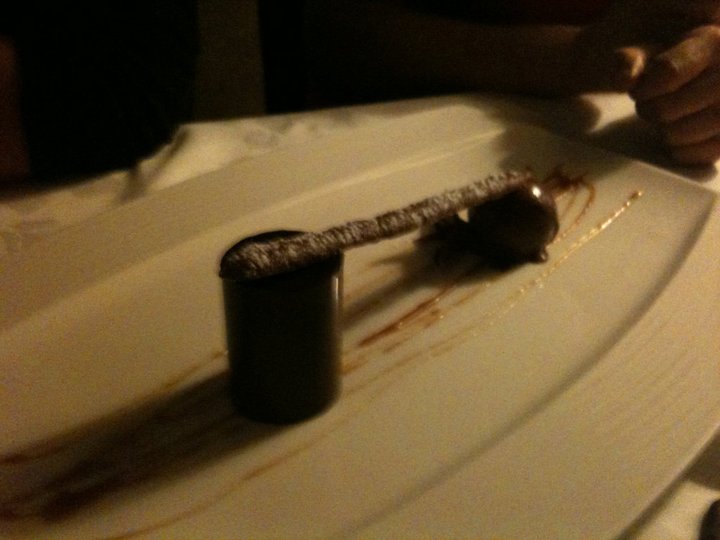
You might think we’d be too stuffed to eat anything else after all that, and you’d be correct. That didn’t stop us, however, having no less than FIVE desserts! I know, I we should be ashamed… but we’re not. After a break, the kitchen sent out: a very decadent chocolate dessert which consisted of a cylindrical dark chocolate casing containing a chocolate, Kaluah and espresso genache with a chocolate sorbet; an assortment of house-made sorbets (mango and blueberry) and vanilla ice cream; a green tea crème bruleé; an utterly moreish passion fruit parfait; and a sweet little rhubarb tart (in perfect puff pastry) with vanilla ice cream. All thanks to pastry chef Sammy who’s been at VM since it opened three years ago.

I am now officially out of food writing words. Suffice to say, in spite of how full we were on finishing off the mains, we left nothing of the desserts. At this point though we were well and truly stuffed. When the pots of peppermint tea and pretty little petits fours arrived, we could only manage a nibble of the macarons (crisp to the tooth, then meltingly soft on the inside) and handmade chocolate truffles (also divine).

Now prepare yourself readers for the biggest shock of all: the dinner menu at VM costs only €58 per head! And €53 if you leave out the dessert course, which in our case was total over indulgence. The wine list is ample, well thought out and reasonably priced, and the early bird is only €35!!

This is why I say VM was the ‘pièce de résistance’ of our journey. It epitomises the excellence and value of Irish food at its best – something we can be so proud of and should be boasting about as far and wide as we can. Likewise Beryl and James Kearney in Viewmount House (and Alan Rooks and Brigene Clafferty in Linsfort Castle) are quietly providing the kind of hospitality you couldn’t get anywhere else. Uniquely ours, worth every reasonable penny and then some, and worth the schlep to these places less visited in our lovely country. So my wish is that other people will read this blog and follow our road trip. You won’t be sorry, you just won’t want to go home.